1729C. Jumping on Tiles
constructive algorithms/strings, 1100, https://codeforces.com/problemset/problem/1729/C
Polycarp was given a row of tiles. Each tile contains one lowercase letter of the Latin alphabet. The entire sequence of tiles forms the string 𝑠.
In other words, you are given a string 𝑠 consisting of lowercase Latin letters.
Initially, Polycarp is on the first tile of the row and wants to get to the last tile by jumping on the tiles. Jumping from 𝑖-th tile to 𝑗-th tile has a cost equal to
Polycarp wants to get to the 𝑛-th tile for the minimum total cost, but at the same time make maximum number of jumps.
In other words, among all possible ways to get to the last tile for the minimum total cost, he will choose the one with the maximum number of jumps.
Polycarp can visit each tile at most once.
Polycarp asks you to help — print the sequence of indices of string 𝑠s on which he should jump.
Input
The first line of the input contains an integer
Each test case is given by the string
It is guaranteed that the sum of string lengths 𝑠 over all test cases does not exceed 2⋅10^5^.
Output
The answer to each test case consists of two lines.
In the first line print two integers 𝑐𝑜𝑠𝑡, 𝑚, where 𝑐𝑜𝑠𝑡 is the minimum total cost of the path, and 𝑚 is the maximum number of visited tiles Polycarp can make to get to 𝑛n-th tiles for the minimum total cost 𝑐𝑜𝑠𝑡 (i.e. the number of jumps is 𝑚−1).
In the next line print 𝑚 different numbers $𝑗_1,𝑗_2,…,𝑗_𝑚 (1≤𝑗_𝑖≤|𝑠|) $— the sequence of indices of the tiles Polycarp will jump on. The first number in the sequence must be 1 (that is, 𝑗~1~=1) and the last number must be the value of |𝑠| (that is, 𝑗~𝑚~=|𝑠|).
If there are multiple answers, print any of them.
Example
input
6
logic
codeforces
bca
aaaaaaaaaaa
adbaadabad
to
output
9 4
1 4 3 5
16 10
1 8 3 4 9 5 2 6 7 10
1 2
1 3
0 11
1 8 10 4 3 5 7 2 9 6 11
3 10
1 9 5 4 7 3 8 6 2 10
5 2
1 2
Note
In the first test case, the required path corresponds to the picture:
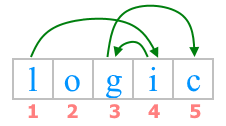
In this case, the minimum possible total cost of the path is achieved. Since 𝑖𝑛𝑑𝑒𝑥('l')=12, 𝑖𝑛𝑑𝑒𝑥('o')=15, 𝑖𝑛𝑑𝑒𝑥('g')=7, 𝑖𝑛𝑑𝑒𝑥('i')=9, 𝑖𝑛𝑑𝑒𝑥('c')=3, then the total cost of the path is |12−9|+|9−7|+|7−3|=3+2+4=9.
for _ in range(int(input())):
    s = input()
    n=len(s)
    a=[]
    l, h = ord(s[0])-96, ord(s[-1])-96
    for i in range(1, n-1):
        a.append([ord(s[i])-96, i+1])
    a.sort()
    if l>h:a.reverse()
    res=[1]
    low, high = min(l, h), max(l, h)
    for v in a:
        if low<=v[0]<=high:
            res.append(v[1])
    res.append(n)
    print(high-low, len(res))
    print(*res)