05442: 兔子与星空
prim, kruskal, http://cs101.openjudge.cn/practice/05442/
很久很久以前,森林里住着一群兔子。兔子们无聊的时候就喜欢研究星座。如图所示,天空中已经有了n颗星星,其中有些星星有边相连。兔子们希望删除掉一些边,然后使得保留下的边仍能是n颗星星连通。他们希望计算,保留的边的权值之和最小是多少?
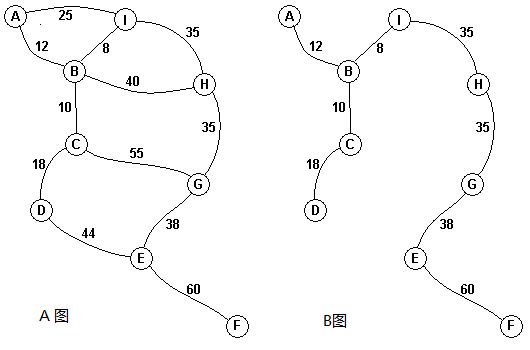
输入
第一行只包含一个表示星星个数的数n,n不大于26,并且这n个星星是由大写字母表里的前n个字母表示。接下来的n-1行是由字母表的前n-1个字母开头。最后一个星星表示的字母不用输入。对于每一行,以每个星星表示的字母开头,然后后面跟着一个数字,表示有多少条边可以从这个星星到后面字母表中的星星。如果k是大于0,表示该行后面会表示k条边的k个数据。每条边的数据是由表示连接到另一端星星的字母和该边的权值组成。权值是正整数的并且小于100。该行的所有数据字段分隔单一空白。该星星网络将始终连接所有的星星。该星星网络将永远不会超过75条边。没有任何一个星星会有超过15条的边连接到其他星星(之前或之后的字母)。在下面的示例输入,数据是与上面的图相一致的。
输出
输出是一个整数,表示最小的权值和
样例输入
9
A 2 B 12 I 25
B 3 C 10 H 40 I 8
C 2 D 18 G 55
D 1 E 44
E 2 F 60 G 38
F 0
G 1 H 35
H 1 I 35
样例输出
216提示
考虑看成最小生成树问题,注意输入表示。
The problem you're describing is a classic Minimum Spanning Tree (MST) problem. The MST problem is a common problem in graph theory that asks for a spanning tree of a graph such that the sum of its edge weights is as small as possible. In this case, the stars represent the nodes of the graph, and the edges between them represent the connections between the stars. The weight of each edge is given in the problem statement. The goal is to find a subset of these edges such that all stars are connected and the sum of the weights of these edges is minimized.
import heapq

def prim(graph, start):
    mst = []
    used = set([start])
    edges = [
        (cost, start, to)
        for to, cost in graph[start].items()
    ]
    heapq.heapify(edges)

    while edges:
        cost, frm, to = heapq.heappop(edges)
        if to not in used:
            used.add(to)
            mst.append((frm, to, cost))
            for to_next, cost2 in graph[to].items():
                if to_next not in used:
                    heapq.heappush(edges, (cost2, to, to_next))

    return mst

def solve():
    n = int(input())
    graph = {chr(i+65): {} for i in range(n)}
    for i in range(n-1):
        data = input().split()
        star = data[0]
        m = int(data[1])
        for j in range(m):
            to_star = data[2+j*2]
            cost = int(data[3+j*2])
            graph[star][to_star] = cost
            graph[to_star][star] = cost
    mst = prim(graph, 'A')
    print(sum(x[2] for x in mst))

solve()
思路:用的kruskal,这个算法比那些用图的算法看起来明白多了
kruskal适配这种vertex.key连续变化的情况,因为并查集建立还有find方法中都要用到列表的有序性。
# 蔡嘉华 物理学院
class DisjSet:
    def __init__(self, n):
        self.parent = [i for i in range(n)]
        self.rank = [0]*n

    def find(self, x):
        if self.parent[x] != x:
            self.parent[x] = self.find(self.parent[x])
        return self.parent[x]

    def union(self, x, y):
        xset, yset = self.find(x), self.find(y)
        if self.rank[xset] > self.rank[yset]:
            self.parent[yset] = xset
        else:
            self.parent[xset] = yset
            if self.rank[xset] == self.rank[yset]:
                self.rank[yset] += 1

def kruskal(n, edges):
    dset = DisjSet(n)
    edges.sort(key = lambda x:x[2])
    sol = 0
    for u, v, w in edges:
        u, v = ord(u)-65, ord(v)-65
        if dset.find(u) != dset.find(v):
            dset.union(u, v)
            sol += w
    if len(set(dset.find(i) for i in range(n))) > 1:
        return -1
    return sol

n = int(input())
edges = []
for _ in range(n-1):
    arr = input().split()
    root, m = arr[0], int(arr[1])
    for i in range(m):
        edges.append((root, arr[2+2*i], int(arr[3+2*i])))
print(kruskal(n, edges))