22485: 升空的焰火,从侧面看
http://cs101.openjudge.cn/practice/22485/
生态文明建设是关系中华民族永续发展的根本大计。近年来,为了响应环保号召,商家们研制出了环保烟花。这类烟花在烟花配方中不采用含有重金属和硫元素的物质,从而减少了硫化物的生成。
为了庆祝院庆,A大学计算机院燃放了一批环保烟花。从正面看,烟花的构成了二叉树的形状。那么从侧面看,烟花又是什么样子的呢?
对于一个二叉树形状的烟花,它有N个节点,每个节点都有一个1~N之间的颜色编号,不同节点的编号互不相同。除了根节点的编号固定为1,其他节点的编号都是随机分配的。
我们需要按照从顶部到底部的顺序,输出从右侧能看到的节点的颜色编号,即输出广度优先搜索中每一层最后一个节点。
例如对于如下的二叉树烟花,从右侧看到的结果为[1, 3, 4]。
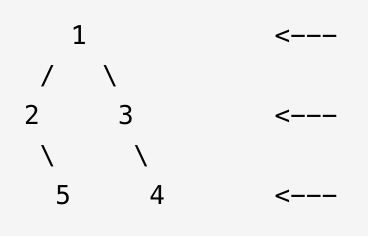
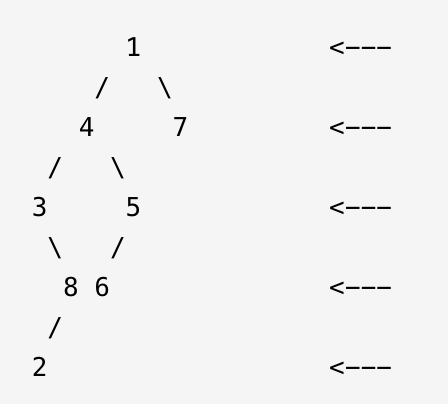
再如,对于如下的二叉树烟花,从右侧看到的结果为[1, 7, 5, 6, 2]。
输入
输入共N+1行。 第1行为一个整数N(1<=N<=1000),表示二叉树中的节点个数。这N个节点的颜色编号分别为1到N,其中1号节点为根节点。 接下来N行每行有两个整数,分别为1~N号节点的左子节点和右子节点的颜色编号,如果子节点为空,则用-1表示。
输出
按从顶到底的顺序,输出从右侧看二叉树看到的各个节点的颜色编号(即广度优先搜索中每一层最后一个节点),每个编号之间用空格隔开。
样例输入
5
2 3
-1 5
-1 4
-1 -1
-1 -1
样例输出
1 3 4提示
(1)一种处理本题的输入形式的方式:可先开辟一个大小为N的数组,存储这N个二叉树节点,然后根据每行输入,将相关节点用左右子节点指针连接起来。 (2)BFS可以借助队列实现,可以使用STL
来源
TA Zhang C.
This problem is about traversing a binary tree in a breadth-first manner and printing the last node of each level when viewed from the right side.
Here is a Python solution using a queue for the breadth-first traversal:
from collections import deque

def right_view(n, tree):
    queue = deque([(1, tree[1])])  # start with root node
    right_view = []

    while queue:
        level_size = len(queue)
        for i in range(level_size):
            node, children = queue.popleft()
            if children[0] != -1:
                queue.append((children[0], tree[children[0]]))
            if children[1] != -1:
                queue.append((children[1], tree[children[1]]))
        right_view.append(node)

    return right_view

n = int(input())
tree = {1: [-1, -1] for _ in range(n+1)}  # initialize tree with -1s
for i in range(1, n+1):
    left, right = map(int, input().split())
    tree[i] = [left, right]

result = right_view(n, tree)
print(' '.join(map(str, result)))
This script first reads the number of nodes and the tree structure from the input. It then calls the right_view function to compute the right view of the tree. The right_view function uses a queue to perform a breadth-first traversal of the tree. It processes all nodes at the current level before moving on to the next level. After processing all nodes at a level, it appends the last node of the level to the right_view list. Finally, it prints the right view of the tree.
# 蒋子轩 工院
def dfs(node,level):
    if ans[level]==0:
        ans[level]=node
    for next in tree[node][::-1]:
        if next!=-1:
            dfs(next,level+1)
n=int(input())
tree={}
ans=[0]*n
for i in range(n):
    tree[i+1]=list(map(int,input().split()))
dfs(1,0)
res=[]
for i in ans:
    if i: res.append(i)
    else: break
print(*res)
直接每次把下一层的入栈,输出最后一个即可
# 童溯 数学科学学院
n = int(input())
tree = [0]
for i in range(n):
    tree.append(list(map(int, input().split())))
stack = [1]
ans = []
while stack:
    ans.append(str(stack[-1]))
    temp = []
    for x in stack:
        if tree[x][0] != -1:
            temp.append(tree[x][0])
        if tree[x][1] != -1:
            temp.append(tree[x][1])
    stack = temp
print(" ".join(ans))