19943: 图的拉普拉斯矩阵
http://cs101.openjudge.cn/practice/19943/
在图论中,度数矩阵是一个对角矩阵 ,其中包含的信息为的每一个顶点的度数,也就是说,每个顶点相邻的边数。邻接矩阵是图的一种常用存储方式。如果一个图一共有编号为0,1,2,…n-1的n个节点,那么邻接矩阵A的大小为n*n,对其中任一元素Aij,如果节点i,j直接有边,那么Aij=1;否则Aij=0。
将度数矩阵与邻接矩阵逐位相减,可以求得图的拉普拉斯矩阵。具体可见下图示意。
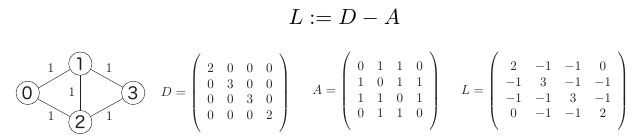
现给出一个图中的所有边的信息,需要你输出该图的拉普拉斯矩阵。
输入
第一行2个整数,代表该图的顶点数n和边数m。 接下m行,每行为空格分隔的2个整数a和b,代表顶点a和顶点b之间有一条无向边相连,a和b均为大小范围在0到n-1之间的整数。输入保证每条无向边仅出现一次(如1 2和2 1是同一条边,并不会在数据中同时出现)。
输出
共n行,每行为以空格分隔的n个整数,代表该图的拉普拉斯矩阵。
样例输入
4 5
2 1
1 3
2 3
0 1
0 2
样例输出
2 -1 -1 0
-1 3 -1 -1
-1 -1 3 -1
0 -1 -1 2
来源
cs101 2019 Final Exam
python
class Vertex:
    def __init__(self, key):
        self.id = key
        self.connectedTo = {}

    def addNeighbor(self, nbr, weight=0):
        self.connectedTo[nbr] = weight

    def __str__(self):
        return str(self.id) + ' connectedTo: ' + str([x.id for x in self.connectedTo])

    def getConnections(self):
        return self.connectedTo.keys()

    def getId(self):
        return self.id

    def getWeight(self, nbr):
        return self.connectedTo[nbr]

class Graph:
    def __init__(self):
        self.vertList = {}
        self.numVertices = 0

    def addVertex(self, key):
        self.numVertices = self.numVertices + 1
        newVertex = Vertex(key)
        self.vertList[key] = newVertex
        return newVertex

    def getVertex(self, n):
        if n in self.vertList:
            return self.vertList[n]
        else:
            return None

    def __contains__(self, n):
        return n in self.vertList

    def addEdge(self, f, t, weight=0):
        if f not in self.vertList:
            nv = self.addVertex(f)
        if t not in self.vertList:
            nv = self.addVertex(t)
        self.vertList[f].addNeighbor(self.vertList[t], weight)

    def getVertices(self):
        return self.vertList.keys()

    def __iter__(self):
        return iter(self.vertList.values())

def constructLaplacianMatrix(n, edges):
    graph = Graph()
    for i in range(n):	# 添加顶点
        graph.addVertex(i)

    for edge in edges:	# 添加边
        a, b = edge
        graph.addEdge(a, b)
        graph.addEdge(b, a)

    laplacianMatrix = []	# 构建拉普拉斯矩阵
    for vertex in graph:
        row = [0] * n
        row[vertex.getId()] = len(vertex.getConnections())
        for neighbor in vertex.getConnections():
            row[neighbor.getId()] = -1
        laplacianMatrix.append(row)

    return laplacianMatrix


n, m = map(int, input().split())	# 解析输入
edges = []
for i in range(m):
    a, b = map(int, input().split())
    edges.append((a, b))

laplacianMatrix = constructLaplacianMatrix(n, edges)	# 构建拉普拉斯矩阵

for row in laplacianMatrix:	# 输出结果
    print(' '.join(map(str, row)))