02533: Longest Ordered Subsequence
dp, http://cs101.openjudge.cn/practice/02533
A numeric sequence of ai is ordered if a~1~ < a~2~ < ... < a~N~. Let the subsequence of the given numeric sequence (a~1~, a~2~, ..., a~N~) be any sequence$ (a_{i_1}, a_{i_2}, ..., a_{i_K})$, where 1 <= i~1~ < i~2~ < ... < i~K~ <= N. For example, sequence (1, 7, 3, 5, 9, 4, 8) has ordered subsequences, e. g., (1, 7), (3, 4, 8) and many others. All longest ordered subsequences are of length 4, e. g., (1, 3, 5, 8).
Your program, when given the numeric sequence, must find the length of its longest ordered subsequence.
输入
The first line of input file contains the length of sequence N. The second line contains the elements of sequence - N integers in the range from 0 to 10000 each, separated by spaces. 1 <= N <= 1000
输出
Output file must contain a single integer - the length of the longest ordered subsequence of the given sequence.
样例输入
7
1 7 3 5 9 4 8
样例输出
4来源
Northeastern Europe 2002, Far-Eastern Subregion
n = int(input())
*b, = map(int, input().split())
dp = [1]*n

for i in range(1, n):
    for j in range(i):
        if b[j] < b[i]:
            dp[i] = max(dp[i], dp[j]+1)

print(max(dp))
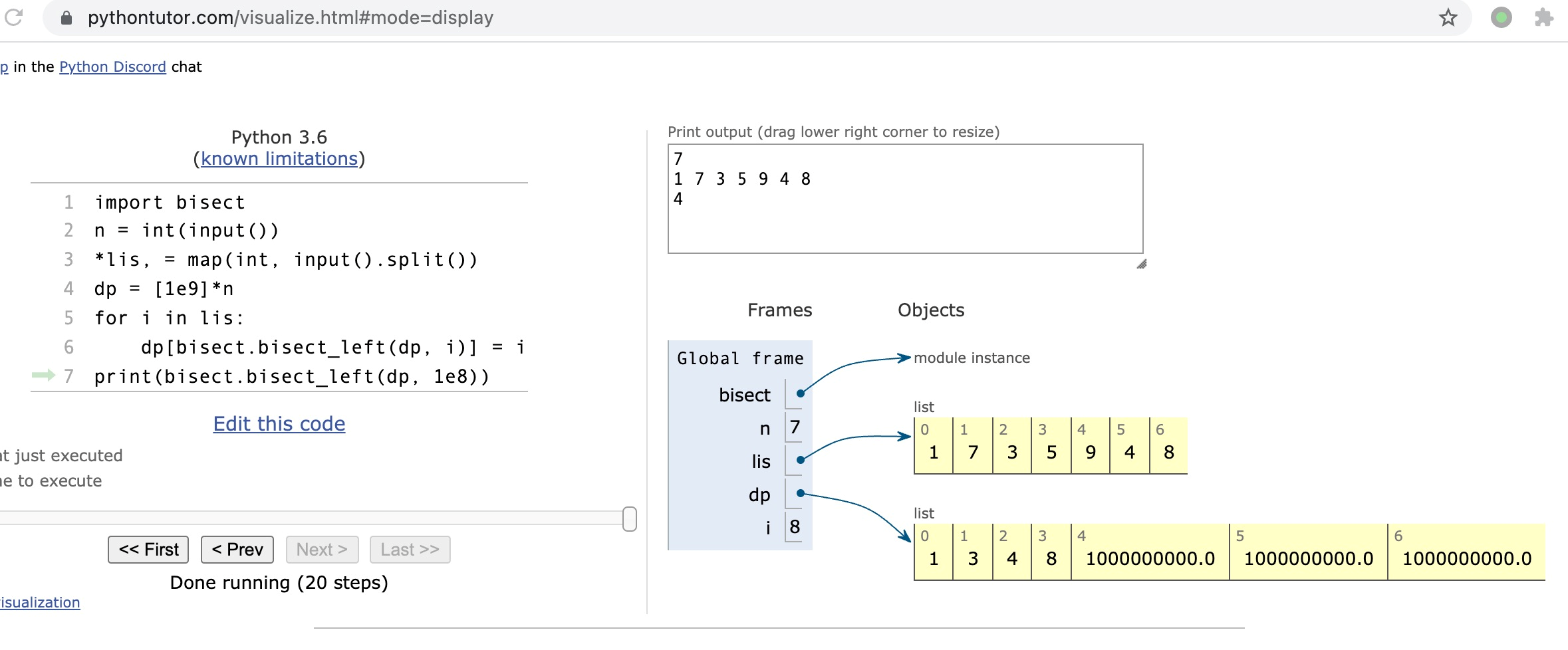
bisect用法,Maintain lists in sorted order, https://pymotw.com/2/bisect/
import bisect
n = int(input())
*lis, = map(int, input().split())
dp = [1e9]*n
for i in lis:
    dp[bisect.bisect_left(dp, i)] = i
print(bisect.bisect_left(dp, 1e8))