T07206: 我是最快的马
bfs, http://cs101.openjudge.cn/pctbook/T07206/
我们都知道,在中国象棋中,马是走日字步的。现给定马的起始坐标与终点坐标,求出马最快能到达的路线。如果有多条路线都是步数最少的,则输出路线的数目 注意,此时棋盘上可能会有一些其它的棋子,这些棋子是会憋马脚的,注意!
输入
前两行为起点坐标与终点坐标,第三行为一个数字M,之后的M行为棋盘上其它棋子的坐标(M<32,坐标行列值<=10)
输出
如果最快路线唯一,则输出路线。否则只输出一个数字,为最快路线的数目N
样例输入
0 0
2 4
1
1 1
样例输出
(0,0)-(1,2)-(2,4)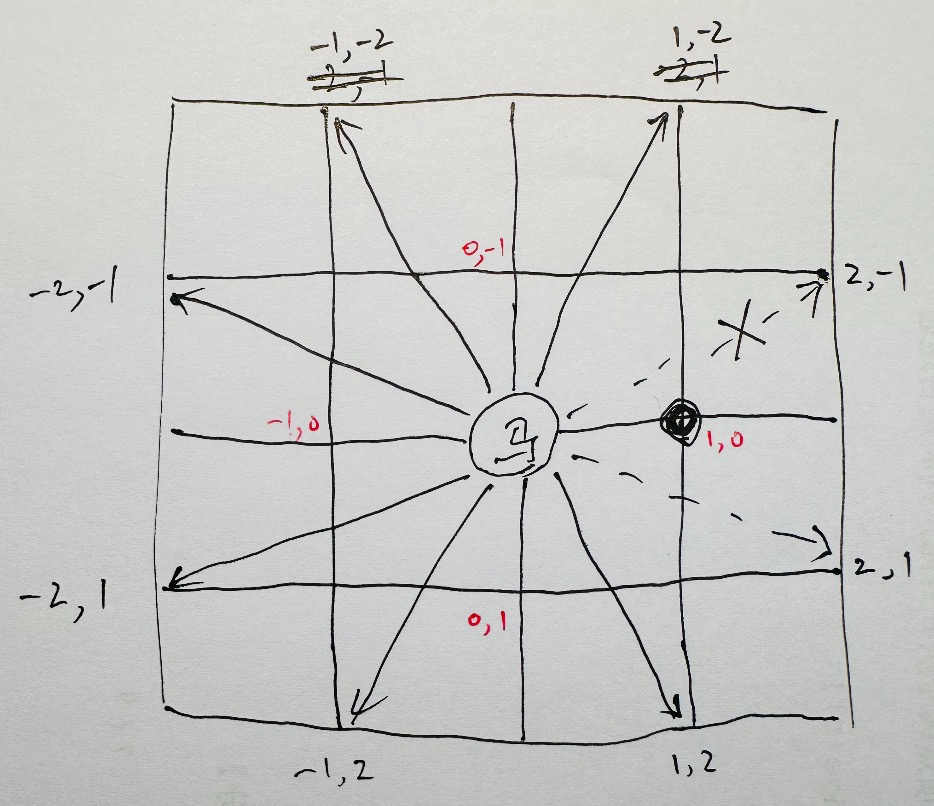
《图 + BFS + 回溯(Path Reconstruction)》标准算法讲义版—— 这是高校算法课/竞赛教程里常用的规范写法,包括:
- 问题建模
- 图表示
- BFS 求最短路
- 记录最短路径条数
- 回溯恢复唯一路径
既可以作为教材,也可以直接讲给学生,非常清晰、标准化。
📘 算法讲义:图 + BFS + 回溯构造最短路径
- 问题模型(Graph Model)
象棋马所在的棋盘是一个 11×11 的网格图,每个格子对应图中的一个「节点」。
马的移动遵循象棋规则,包含 蹩马脚,因此每个节点到周围节点的边是否存在要按规则动态判断:
- 若马脚位置被障碍占据,则该方向无法移动;
- 若落点是障碍,也无法移动;
- 每次移动的代价均为 1(无权图)。
因此,该问题是一个 无权图最短路径 + 路径数量统计 + 唯一路径恢复 的综合问题。
2. 图的邻接规则(Implicit Graph)
我们不需要提前建好所有边,而是 BFS 时动态判断可移动方向。
每个方向包含两个坐标:
(dx, dy): 马的最终落点(bx, by): 马腿位置,用于判断蹩马脚
3. BFS:求最短路 + 最短路径条数
对无权图,最短路可以用 BFS 求。
我们维护三个结构:
3.1 dist[x][y]
记录起点到每个点的 最短步数 默认值为 INF。
3.2 ways[x][y]
记录到达 (x, y) 的 最短路径条数。
当访问一个新节点:
- 第一次到达:
dist[nx][ny] = dist[x][y] + 1ways[nx][ny] = ways[x][y] - 若再次遇到另一条同样长度的路径:
ways[nx][ny] += ways[x][y]
3.3 prev[x][y]
只在 唯一路径 的情况下记录路径的前驱。
- 初次访问且
ways[cur]==1→ 可以记前驱 - 若一个节点出现多条最短路径 → 立即将
prev[x][y] = None(说明不再唯一)
这是一个非常经典的技巧:
BFS 负责“是否唯一”判断; 若唯一才记录前驱,否则取消前驱。
这样既高效又不丢信息。
4. 回溯恢复唯一路径(Path Reconstruction)
若终点 (ex, ey) 满足:
ways[ex][ey] == 1说明最短路径唯一,可以从 prev[][] 中沿着前驱链逆向回溯:
end → ... → start然后反转即可得到:
start → ... → end若 ways > 1,题目要求只输出条数,不恢复路径。
⭐ 完整“讲义版”代码(结构最规范、最适合教学)
def solve():
    from collections import deque

    # ---------- 输入 ----------
    sx, sy = map(int, input().split())
    ex, ey = map(int, input().split())
    M = int(input())

    N = 11
    obs = set()
    for _ in range(M):
        r, c = map(int, input().split())
        obs.add((r, c))

    # ---------- 马的图邻接规则:8 个方向 + 蹩马腿 ----------
    moves = [
        (2,1,1,0), (2,-1,1,0),
        (-2,1,-1,0), (-2,-1,-1,0),
        (1,2,0,1), (-1,2,0,1),
        (1,-2,0,-1), (-1,-2,0,-1)
    ]

    # ---------- BFS 核心 ----------
    start = (sx,sy)
    end = (ex,ey)
    dist = {start: 0}   # 最短距离
    ways = {start: 1}     # 最短路径数量
    prev = {start: None}  # 唯一路径的前驱

    q = deque([start])

    while q:
        x, y = q.popleft()
        d = dist[(x, y)]

        for dx, dy, bx, by in moves:
            # 1. 判断蹩马腿是否被障碍阻挡
            legx, legy = x + bx, y + by
            if 0 <= legx < N and 0 <= legy < N and (legx, legy) in obs:
                continue

            # 2. 判断落点合法
            nx, ny = x + dx, y + dy
            if not (0 <= nx < N and 0 <= ny < N):
                continue
            if (nx, ny) in obs:
                continue

            new_pos = (nx, ny)
            nd = d + 1

            # 3. 第一次到达该节点:更新最短路、路径数量、前驱
            if new_pos not in dist:
                dist[new_pos] = nd
                ways[new_pos] = ways[(x, y)]

                # 若前驱唯一路径才记录,之后若出现多路径会被取消
                prev[new_pos] = (x, y) if ways[(x, y)] == 1 else None

                q.append(new_pos)

            # 4. 发现另一条同长度的路径:累加路径数量
            elif nd == dist[new_pos]:
                ways[new_pos] += ways[(x, y)]
                prev[new_pos] = None  # 不再唯一

    # ---------- 输出 ----------
    # 不可达
    if end not in dist:
        print("无解")
        return

    # 多条路径:只输出数目
    if ways[end] > 1:
        print(ways[end])
        return

    # 唯一路径:回溯重建路径
    path = []
    cur = end
    while cur is not None:
        path.append(cur)
        cur = prev[cur]
    path.reverse()

    print("-".join(f"({x},{y})" for x, y in path))


solve()
📍 教学重点总结
1. 本题是典型的图最短路径问题:无权图 → BFS 最短路
2. 额外统计「最短路径数量」:ways 数组
3. 只有在路径唯一时才记录 prev 才能回溯
4. 回溯构造路径:从终点沿 prev 一直追到起点
def solve():
    import sys
    from collections import deque
    start_r, start_c = map(int, input().split())
    end_r, end_c = map(int, input().split())
    M = int(input())
    obstacles = set()
    for _ in range(M):
        r, c = map(int, input().split())
        obstacles.add((r, c))

    # 棋盘坐标范围
    MIN, MAX = 0, 10

    # 马的走法:每个元组为(dx, dy, (block_dx, block_dy))
    moves = [
        (2, 1, (1, 0)), (2, -1, (1, 0)),
        (-2, 1, (-1, 0)), (-2, -1, (-1, 0)),
        (1, 2, (0, 1)), (-1, 2, (0, 1)),
        (1, -2, (0, -1)), (-1, -2, (0, -1))
    ]

    def in_bounds(pos):
        r, c = pos
        return MIN <= r <= MAX and MIN <= c <= MAX

    start = (start_r, start_c)
    end = (end_r, end_c)

    # BFS:dist记录最短步数,ways记录最短路径数,prev在唯一路径时记录前驱便于重构路径
    dist, ways, prev = {}, {}, {}
    dist[start] = 0
    ways[start] = 1
    prev[start] = None
    q = deque([start])

    while q:
        cur = q.popleft()
        r, c = cur
        for dx, dy, (br, bc) in moves:
            # 计算“蹩马腿”所在位置
            block = (r + br, c + bc)
            # 如果该位置在棋盘上且被其它棋子占据,则该方向走法被阻挡
            if in_bounds(block) and block in obstacles:
                continue
            newPos = (r + dx, c + dy)
            if not in_bounds(newPos) or newPos in obstacles:
                continue
            nd = dist[cur] + 1
            if newPos not in dist:
                dist[newPos] = nd
                ways[newPos] = ways[cur]
                # 若当前点只有一条路径,则记录前驱;如果不唯一,则设为None
                prev[newPos] = cur if ways[cur] == 1 else None
                q.append(newPos)
            elif nd == dist[newPos]:
                ways[newPos] += ways[cur]
                # 前驱不再唯一
                prev[newPos] = None

    # 如果目标不可达,输出"无解"
    if end not in dist:
        print("无解")
        return

    # 如果只有唯一一条最短路径,则重构路径输出格式 "(r,c)-(r,c)-..."
    if ways[end] == 1:
        path = []
        cur = end
        while cur is not None:
            path.append(cur)
            cur = prev[cur]
        path.reverse()
        route_str = "-".join("({},{})".format(r, c) for r, c in path)
        print(route_str)
    else:
        # 多条最短路径则输出路径数目
        print(str(ways[end]))


if __name__ == '__main__':
    solve()

"""
0 0
2 2
0

16
"""
另外,题面“坐标行列值<=10” 没有说明是否可以到-10。如果 MIN, MAX = -10, 10范围,上例输入情况下结果是54。