19959: 倍数求和
http://cs101.openjudge.cn/practice/19959/
输入一个数正整数n (n <= 10^12),求式子
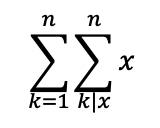 的值。也就是求k在[1,n]内的所有倍数和。
 输入
第一行为一个正整数n,n<=10^12
输出
计算式子的值
样例输入
Sample1 Input:
9

Sample1 Output:
130

解释: k=1时,x取1,2,3,4,5,6,7,8,9,合计45;k=2时,x取2,4,6,8,合计20;k=3时,x取3,6,9,合计18;k=4时,x取4,8,合计12;k=5、6、7、8、9时,x分别取5,6,7,8,9,合计35;式子的值即总和为130
样例输出
Sample2 Input:
15

Sample2 Output:
406

Sample3 Input:
1

Sample3 Output:
1
来源
cs101-2019 周畅
python
def calculate_sum(n):
    # 快速计算 1 到 n 的和
    def sum_range(x):
        return x * (x + 1) // 2

    # 主要逻辑
    result = sum_range(n)
    k = n // 2
    temp1 = 2

    while k >= 1:
        temp2 = (n // k) + 1
        # 当前范围和
        range_sum = sum_range(temp2 - 1) - sum_range(temp1 - 1)
        # 更新结果
        result += range_sum * (k * (k + 1)) // 2
        # 更新 k 和 temp1
        k = n // temp2
        temp1 = temp2

    return result

# 输入
n = int(input())
print(calculate_sum(n))
该解法高效地计算了以下数学表达式的总和:
它利用了数学优化方法,使得时间复杂度降至 $ O(\sqrt{n}) $。 关键概念
sum_range(x)计算 1 到 x 的和pythondef sum_range(x): return x * (x + 1) // 2
- 该函数返回从 1 到 ( x ) 的所有整数的和,利用了求和公式:
第一步:初始化
resultpythonresult = sum_range(n)
- 由于所有数(1 到 n )都至少被 1 整除一次,首先将其总和加到
result中:核心优化:合并计算多个
k值的贡献pythonk = n // 2 temp1 = 2
k = n // 2表示当前处理的k取值,初始设为 ( n // 2 )。temp1 = 2作为区间下界。核心循环
pythonwhile k >= 1: temp2 = (n // k) + 1
temp2计算n // k变化的下一段边界。- 关键思想是:当 ( k ) 在一定范围内时,
n // k的值是恒定的。- 例如,若
n = 9:
k = 1时:n // 1 = 9k = 2时:n // 2 = 4k = 3,4时:n // k = 3k = 5,6,7,8,9时:n // k = 1- 这些可以被分段处理,而非单独计算每个
k。计算当前
k对result的贡献pythonrange_sum = sum_range(temp2 - 1) - sum_range(temp1 - 1)
range_sum计算区间[temp1, temp2-1]内的整数和,表示k在[temp1, temp2-1]内的所有x贡献的总和。- 计算方式:用
sum_range(temp2-1)减去sum_range(temp1-1),即:更新
resultpythonresult += range_sum * (k * (k + 1)) // 2
range_sum是某段k范围的整数之和。(k * (k + 1)) // 2是k的倍数和公式:- 将两者相乘,即得到
k在该范围对最终result的贡献。更新
k和temp1pythonk = n // temp2 temp1 = temp2
- 由于
temp2是n // k + 1,k更新为n // temp2,即k直接跳到下一个区间的最大k。temp1 = temp2,下次迭代时新的temp1代表当前区间的起点。时间复杂度分析
- 由于
k每次按n // k变化,k变化的次数大约是O(√n)(因为n // k主要变化在√n左右)。- 因此,该解法的时间复杂度为
O(√n),远优于O(n)的朴素解法。示例分析
输入
n = 9计算过程
sum_range(9) = 45,初始化result = 45- 进入循环:
k=4, temp1=2temp2=5,计算[2, 4]的range_sum = sum_range(4) - sum_range(1) = 10 - 1 = 9- 贡献
9 × (4×5/2) = 9 × 10 = 90- 更新
result = 45 + 90 = 135k = 9//5 = 1, temp1 = 5- 继续:
temp2 = 10range_sum = sum_range(9) - sum_range(4) = 45 - 10 = 35- 贡献
35 × (1×2/2) = 35 × 1 = 35result = 135 + 35 = 130- 终止循环。
最终输出:
130总结
- 该方法利用数学优化,跳过了
O(n)的计算,实现O(√n)复杂度。- 通过
sum_range(x)快速求和,避免逐个遍历k。- 通过
temp1和temp2分段处理,确保k只计算关键区间。- 适用于
n最大到 ( 10^{12} ),高效且实用。该解法比直接暴力求解 快很多,是一个巧妙的数学优化方法! 🚀
python
def main():
    import sys
    input_data = sys.stdin.read().strip()
    if not input_data:
        return
    n = int(input_data)
    ans = 0
    k = 1
    # Process intervals where floor(n/k) remains constant.
    while k <= n:
        m = n // k         # For current k, m is floor(n/k)
        r = n // m         # r is the maximum k with the same floor(n/k)
        # Sum of k in the interval [k, r]
        sum_k = (k + r) * (r - k + 1) // 2
        # For each k, the sum of its multiples up to n is k * (1+2+...+floor(n/k))
        # and the inner sum equals m*(m+1)//2.
        ans += sum_k * (m * (m + 1) // 2)
        k = r + 1

    print(ans)

if __name__ == "__main__":
    main()
Explanation
Understanding the Problem:
- For each integer ( k ) from 1 to ( n ), we need to sum up all multiples of ( k ) that are less than or equal to ( n ).
- The multiples of ( k ) are $ k, 2k, 3k, \dots, \lfloor \frac{n}{k} \rfloor \cdot k $.
- The sum for a fixed ( k ) is $ k \times \frac{\lfloor \frac{n}{k} \rfloor (\lfloor \frac{n}{k} \rfloor + 1)}{2} $.
Optimization:
- Since ( n ) can be as large as ( 10^{12} ), iterating from 1 to ( n ) is not feasible.
- We optimize by grouping intervals where $ \lfloor \frac{n}{k} \rfloor $ remains constant.
- For a given $ m = \lfloor \frac{n}{k} \rfloor $, the value of ( k ) remains constant for ( k ) in the interval ([L, R]) where $ L = \lfloor \frac{n}{m+1} \rfloor + 1 $ and $ R = \lfloor \frac{n}{m} \rfloor $.
Algorithm:
- Use a while-loop to process segments of ( k ) where $ \lfloor \frac{n}{k} \rfloor $ is constant.
- Compute the sum of ( k ) over each segment using the arithmetic sum formula.
- Multiply the segment sum by $ \frac{m(m+1)}{2} $ (the sum of numbers from 1 to m ).
- Add to the final answer and move k to the next segment.
Input/Output:
- The program reads the input number n and prints the computed result.
This solution efficiently computes the desired sum even for very large values of n .