23558: 有界的深度优先搜索
dfs, http://cs101.openjudge.cn/practice/23558/
深度优先搜索 (Depth-first Search, DFS) 是一种常用的搜索算法,可以对树或图的节点进行遍历。其过程简要来说是对每一个可能的分支路径深入到不能再深入为止,而且每个节点只能访问一次。在人工智能中,我们有时会将问题抽象为一个用图表示的状态空间,图中的每个节点表示一种状态,节点之间的边表示状态间可以发生转换(简单起见,这里我们认为边是无向的)。例如在下图中,共有0-6七个状态。从节点0开始用DFS算法遍历该图,假设一个节点连接的多个其他节点遍历的顺序为按编号从小到大,则节点的遍历序列为 0 -> 1 -> 2 -> 3 -> 4 -> 5 -> 6
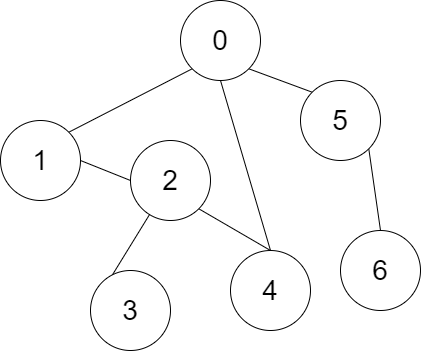
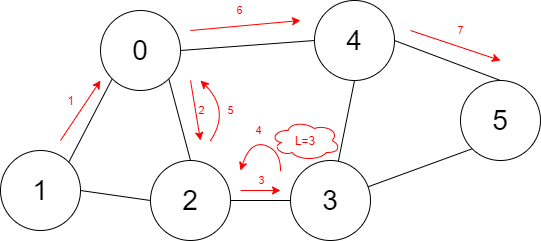
一些实际问题的状态空间可能很大甚至是无限的,此时DFS算法会沿某条路径无穷地搜索下去,以至于算法无法正常结束。针对这个问题,我们可以使用一种改进的有界深度优先搜索 (Depth-limited Search, DLS) 算法。DLS与DFS的唯一不同点在于其有一个最大深度 L ,在搜索过程中,如果当前路径的搜索深度超过了 L,则认为当前分支不能继续向下并直接返回。注意,当前分支向下的各节点还可能通过其他路径到达。仍以上图为例,假设最大搜索深度 L=2 ,则其遍历序列为 0 -> 1 -> 2 ->(达到深度界限返回)-> 4 -> 5 -> 6。下图是另一个例子,红色线代表了搜索的顺序。DLS搜索可能无法完全探索状态空间,但能保证正常结束。对于一个给定的图和深度 L ,请你实现DLS算法,并输出从给定节点开始DLS搜索产生的遍历序列。在此问题背景下,遍历序列中不需要包含那些与初始节点不连通的节点。
输入
第一行是三个正整数 n, m, L,表示图的节点个数、边数和最大搜索深度。节点的编号为0到n-1。 n <= 100
接下来 m 行,每行为空格分隔的2个整数 a和 b ,代表顶点 a 和顶点 b 之间有一条无向边相连。输入边不会重复,例如输入 a, b 后,后面的行都不会出现 a, b 和 b, a 。
接下来一行是一个0到n-1的整数,代表搜索的开始节点 start 。
输出
一行由空格分隔的数字(节点编号),即使用DLS算法从 start 节点开始,遍历得到的节点访问序列。对于同一个节点连接的多个其他节点,遍历的顺序为按编号从小到大。
样例输入
Sample Input1:
7 7 2
0 1
1 2
2 3
2 4
0 4
0 5
5 6
0

Sample Output1:
0 1 2 4 5 6
样例输出
Sample Input2:
6 8 3
1 0
0 2
1 2
0 4
2 3
4 3
4 5
3 5
1

Sample Output2:
1 0 2 3 4 5

Sample Input3:
6 5 6
0 2
0 1
1 5
0 3
2 3
4

Sample Output3:
4

说明:因为没有结点与4连通。
提示:tags: dfs
来源:2021fall-cs101, zyn
def dls(n, m, L, edges, start):
    # 构建图的邻接表
    graph = {i: [] for i in range(n)}
    for a, b in edges:
        graph[a].append(b)
        graph[b].append(a)

    # 按节点编号从小到大排序邻接表
    for node in graph:
        graph[node].sort()

    # 深度限制搜索 (DLS)
    visited = []
    def dfs(node, depth):
        if depth > L:
            return
        visited.append(node)
        for neighbor in graph[node]:
            if neighbor not in visited:
                dfs(neighbor, depth + 1)

    dfs(start, 0)
    return visited

# 输入
n, m, L = map(int, input().split())
edges = [tuple(map(int, input().split())) for _ in range(m)]
start = int(input())

# 调用函数并输出结果
result = dls(n, m, L, edges, start)
print(" ".join(map(str, result)))
7 9 3 1 0 0 2 1 2 0 4 2 3 4 3 4 5 3 5 3 6 1
访问不到6。题面要求“遍历的顺序为按编号从小到大”,访问了0,就到不了6,深度超过3了。
# 有界的深度优先搜索
n, m, l = map(int, input().split())
graph = dict()
visited = [False] * n
for _ in range(m):
    s, e = map(int, input().split())
    if s not in graph.keys():
        graph[s] = [e]
    else:
        graph[s].append(e)

    if e not in graph.keys():
        graph[e] = [s]
    else:
        graph[e].append(s)

for i in graph:
    graph[i].sort()

route = []
def dfs(cur, depth):
    if visited[cur] or depth > l:
        return
    visited[cur] = True
    route.append(cur)

    if cur not in graph.keys():
        return

    for next in graph[cur]:
        dfs(next, depth+1)

start = int(input())
dfs(start, 0)
#print(' '.join([str(x) for x in route]))
print(*route)